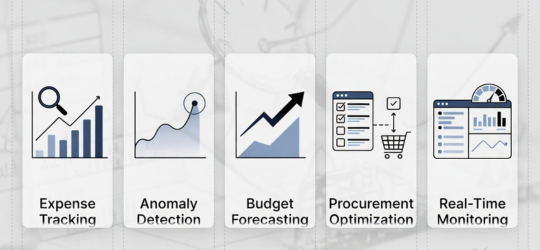
AI doesn’t just crunch numbers faster — it uncovers hidden cost leaks, predicts future spending, and shifts financial management from reactive to proactive.
In an era of tight budgets and rapid decision-making, Cost Controllers play a crucial role in financial discipline. But traditional spreadsheets and month-end reconciliations keep you reacting to yesterday’s costs, not controlling today’s.
Artificial Intelligence changes that equation entirely. By automating the grunt work of data entry and reconciliation, AI frees finance teams to focus on strategy, risk management, and profitability. Here are the five highest-impact ways to put it to work immediately.
Automate Expense Tracking and Reporting
Manual data entry, reconciliations, and report generation eat up valuable hours and increase the risk of compounding errors. AI eliminates the cycle entirely.
Extracts data from invoices, receipts, and PDFs using AI Document Intelligence — no manual entry. Categorises and reconciles transactions in real time, eliminating month-end delays.
60–70% reduction in manual accounting time. Faster close cycles, improved accuracy, and finance teams freed to focus on analysis — not data cleanup.
Finance teams processing high volumes of vendor invoices, employee expenses, or multi-entity reconciliations on a weekly or monthly basis.
Detect Cost Leakages and Anomalies Instantly
Duplicate payments, vendor overbilling, and unauthorised spending are the quiet killers of profit. AI scans millions of data points in real time — something no human auditor can match.
Flags duplicate invoices, pricing inconsistencies, and vendor overbilling in real time. Detects unusual patterns early — before they become major losses or compliance issues.
Stops financial fraud and errors before payment. Transforms auditing from a periodic review into continuous, automated monitoring with instant leadership alerts.
Businesses with high transaction volume, multiple vendors, or distributed procurement where manual review is simply not scalable.
Predict Budgets and Forecast Costs with Accuracy
Traditional budgeting is a mix of guesswork and static assumptions. AI-driven forecasting is dynamic — automatically incorporating live data, seasonality, and market signals.
Incorporates historical data, seasonality, inflation, and supply trends using machine learning. Creates rolling forecasts that adjust automatically with real-time performance data.
Simulates multiple what-if scenarios instantly. Produces more reliable, board-ready budgets. Significantly reduces emergency spend and improves capital allocation.
CFOs and FP&A teams at mid-market and enterprise businesses who need to move from annual static budgets to continuous, data-driven financial planning.
Automate Vendor & Procurement Analysis
Vendor management is one of the biggest cost control challenges. AI brings measurement, transparency, and negotiation leverage to an area traditionally driven by relationships over data.
Compares vendor pricing across time, volume, and geography. Analyses contract terms and service levels using AI document parsing to surface hidden risks and missed clauses.
Ensures you never pay above market rate. Maximises negotiation leverage with data-backed positions. Highlights renegotiation opportunities across your entire vendor portfolio.
Procurement teams managing 20+ vendors or complex multi-year contracts where manual analysis creates blind spots that cost money quarter over quarter.
Real-Time Cost Monitoring & Decision Dashboards
Cost control used to be retrospective — you found out what went wrong at month-end. AI makes it continuous and predictive, putting decision power in leadership’s hands at any moment.
Combines siloed data (ERP, CRM, HRMS) into one live unified dashboard. Highlights cost hotspots instantly. Sends automated alerts with action suggestions before problems escalate.
Single source of truth for all cost data. Eliminates financial surprises at board reviews. Accelerates decision-making from days to minutes across the entire leadership team.
CEOs, CFOs, and department heads who need a live view of spend vs. budget — without waiting for the finance team to pull and format reports manually.
How can AI help cost controllers reduce expenses?
AI automates expense tracking, detects duplicate payments and anomalies in real time, generates rolling forecasts, analyses vendor contracts, and delivers live monitoring dashboards — collectively reducing costs by 10–30% across different categories.
What AI tools are best for financial cost control?
Top tools include ChatGPT for report generation, Power BI with Copilot for dashboards, Zoho Analytics AI for forecasting, SAP Ariba and Coupa AI for procurement, and Omovera’s custom engines for document intelligence and anomaly detection.
Can AI detect cost leakages and fraud automatically?
Yes. AI scans millions of transactions in real time to flag duplicate invoices, vendor overbilling, and unusual patterns — typically before payment is made, transforming auditing into continuous monitoring.
How accurate is AI-based budget forecasting vs. traditional methods?
Significantly more accurate — AI incorporates live data, seasonality, inflation, and supply trends dynamically. Organisations typically see 15–25% improvement in budget accuracy and a major reduction in unplanned emergency spend.