🌍 A Decade of Reinvention Ahead
Artificial Intelligence is no longer the future — it’s the present quietly reshaping how white-collar professionals work, think, and deliver.
From project managers and analysts to HR specialists and accountants, AI tools like ChatGPT, Gemini, Copilot, and Claude are already augmenting daily workflows. What used to take hours — writing reports, analyzing spreadsheets, responding to emails — can now be done in minutes.
By 2030, this wave of intelligent automation will evolve from “helping humans work faster” to redesigning the very structure of knowledge work.
According to McKinsey Global Institute, “up to 30% of work hours could be automated by the end of this decade.” The result? Fewer routine tasks, more strategic thinking, and a massive reskilling requirement.
1️⃣ From Task Automation to Role Transformation
In the 2010s, automation meant robots in factories.
In the 2020s, it’s digital bots in offices.
AI doesn’t just automate — it augments. Instead of replacing an accountant, it becomes their co-pilot, reconciling invoices, preparing summaries, and flagging anomalies automatically.
By 2030, white-collar work will shift from “doing tasks” to managing and validating outputs generated by AI systems.
Paralegals
Won’t manually review contracts — AI models like Harvey will summarize key clauses and risks.
Financial Analysts
Will rely on Gemini-like systems to interpret market data in real time.
Customer Service
Will supervise AI chat agents handling 80% of inbound queries.
In other words, the role stays, but the work changes — dramatically.
2️⃣ Productivity Surge Without Proportional Headcount Growth
A striking truth about AI-driven work: it enables more output without hiring more people.
A Boston Consulting Group study shows that AI-assisted professionals complete tasks 25% faster with 40% higher quality than those working unaided.
That means by 2030:
- Companies will double output with the same workforce.
- Productivity will rise, but job growth will plateau in many white-collar sectors.
- Firms will compete on AI capability per employee, not just employee count.
📊 Real Example
A mid-sized consultancy using ChatGPT-based document summarization tools reduced project-report drafting time from 6 hours to 45 minutes. No layoffs — but no new hires either.
3️⃣ The Skill Shift: From Knowledge Retention to AI Collaboration
AI can store and recall all the information in the world — so human value will move elsewhere.
By 2030, these will be the most valuable skills:
Essential Future Skills
White-collar professionals will need to “train, test, and trust” AI, not fear it.
📘 Example
An HR executive may not write code, but they’ll train Gemini to shortlist resumes, explain selection rationale, and write feedback messages — a blend of HR insight + AI prompt fluency.
4️⃣ Collaboration Models: Humans and AI as Co-Workers
The future isn’t “humans vs machines.” It’s humans + AI = performance multiplier.
By 2030, we’ll see hybrid work structures such as:
- AI Analysts embedded into teams, producing insights before meetings.
- Virtual Associates that schedule, summarize, and coordinate projects autonomously.
- AI copilots for every professional suite — Office, Google Workspace, Zoho, Salesforce.
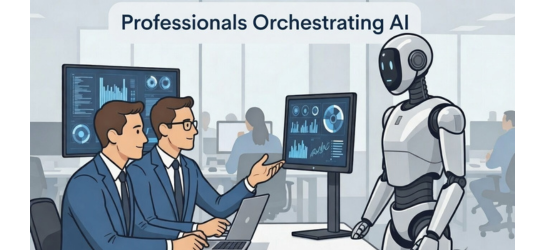
The typical “knowledge worker” will be orchestrating workflows across multiple AI assistants rather than operating alone.
🧠 Example
In a law firm, one human partner could supervise 10 AI agents doing legal research, precedent search, and case summaries — freeing time for human interpretation and client strategy.
5️⃣ Job Impact: Displacement, Creation, and Rebirth
Every industrial revolution creates new roles while transforming old ones — the AI revolution is no exception.
Jobs Likely to Evolve or Decline
- Data entry clerks
- Customer support executives
- Basic analysts and coordinators
- Junior research and documentation roles
Jobs That Will Emerge
- AI Workflow Designer
- Human-AI Collaboration Specialist
- Prompt & Context Engineer
- AI Governance & Compliance Manager
The future isn’t fewer jobs, it’s different jobs — built around human oversight, creativity, and ethics.
6️⃣ Leadership & Organizational Strategy in the AI Era
For leaders, AI transformation isn’t just a tech investment — it’s a management philosophy.
By 2030, companies that thrive will be those that:
- Audit their workflows and prioritize AI-augmentable tasks
- Upskill employees instead of replacing them
- Treat AI tools as productivity partners, not threats
- Create ethical guidelines for AI use
- Measure “AI efficiency” alongside financial KPIs
🧩 Example
A global logistics firm built a “Human + AI” dashboard — measuring not just delivery time, but how AI recommendations improved route optimization. The metric wasn’t cost-cutting, but human-AI synergy.
7️⃣ The Psychological Shift: Trust, Transparency, and Control
For many professionals, trusting AI outputs will be as big a leap as using them.
Organizations will need to build AI literacy and trust frameworks, ensuring:
- Transparent reasoning (why AI gave an answer)
- Human override mechanisms
- Ethical, bias-free training data
The companies that succeed will position AI as a reliable colleague, not a black box.
8️⃣ The Global Impact: Economic Acceleration and Inequality Risks
AI’s productivity surge could add $15 trillion to global GDP by 2030 (PwC projection).
But — the benefits won’t be equally distributed.
Developed economies with advanced AI ecosystems will accelerate faster than emerging markets relying on traditional service exports.
Thus, AI readiness and education become the next competitive frontier for nations, not just corporations.
🌐 By 2030: A Snapshot of the White-Collar Future
| Aspect | 2024 | 2030 |
|---|---|---|
| Work Model | Human-driven with digital tools | AI-augmented, task delegation to bots |
| Decision-Making | Manual review, slow reporting | Real-time AI insights, human validation |
| Skill Focus | Domain knowledge | AI fluency + judgment + creativity |
| Hiring Pattern | Volume-based | Capability-based (AI leverage per head) |
| Output per Employee | Moderate | 2–4× higher via automation |
| Management KPI | Efficiency | AI + human synergy |
🧭 How Professionals Can Prepare
- Adopt AI early: Start using ChatGPT, Gemini, or Copilot to understand limitations.
- Build prompt literacy: Learn to instruct AI clearly and strategically.
- Track your replaceable tasks: Automate them before someone else does.
- Strengthen soft skills: Leadership, empathy, and persuasion will rise in value.
- Document your workflow: So it’s easier to delegate parts to AI in the future.
🏁 The AI Renaissance of White-Collar Work
By 2030, the “white-collar revolution” won’t be about job losses — it’ll be about job metamorphosis.
AI will take over the mechanical parts of thinking — the repetitive, predictable, time-consuming layers — leaving humans to handle creativity, empathy, and complex judgment.
Those who adapt will find AI their most powerful collaborator.
Those who resist will find it their most efficient competitor.
The next seven years are not about replacing workers — they’re about retraining the workforce for the age of intelligent machines.